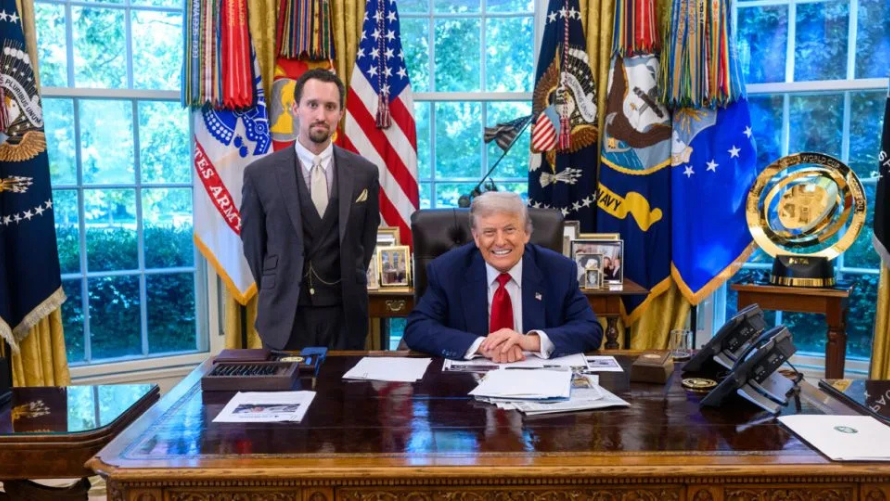
The White House has formally withdrawn President Donald Trump’s controversial pick, E.J. Antoni, to lead the Bureau of Labor Statistics (BLS), according to multiple reports. The move follows a firestorm over Antoni’s since-deleted social media history and mounting opposition in the Senate, which made his confirmation unlikely.
Trump had nominated Antoni in August after abruptly firing Erika McEntarfer, accusing her of “rigging” the July jobs report. That release showed weaker-than-expected U.S. job growth and steep downward revisions to May and June payroll data. While Trump claimed manipulation, the revisions were consistent with long-standing BLS methodologies, which rely on probability-based survey samples.
Why This Matters for Markets
The BLS, established in 1884, is one of the most important independent institutions underpinning U.S. economic credibility. Its monthly employment reports are among the most closely watched indicators worldwide, influencing everything from Federal Reserve policy to forex trading strategies, indices performance, and even sentiment in the crypto market .
With the pace of global trading accelerating—often down to seconds in high-frequency markets—investors rely heavily on credible and timely BLS data. Any perception of political interference threatens to erode that trust, creating added volatility in FX pairs (USD/MXN, USD/CAD, USD/JPY) and equity indices sensitive to U.S. labor market signals.
The Political Overhang
- Nomination Withdrawn: Senate Republicans, including Sens. Susan Collins and Lisa Murkowski, signaled reluctance to back Antoni, citing concerns over his conduct and partisanship.
- Trump’s Track Record: The episode adds to a pattern of Trump challenging independent economic institutions, from the Federal Reserve to the BLS.
- Next Steps: The White House is expected to announce another nominee soon, but questions remain about whether the next candidate will preserve or weaken BLS independence.
Antoni, meanwhile, will return to his post as chief economist at the Heritage Foundation, where he is likely to continue advocating for reforms in how the BLS operates.
Impact on Investors and Traders
- FX & Rates Markets:
- The credibility of U.S. jobs data directly affects Fed rate expectations, shaping the U.S. dollar’s performance.
- Recent steep payroll revisions already jolted USD pairs, reviving volatility in forex trading strategies involving the peso (USD/MXN), loonie (USD/CAD), and yen (USD/JPY).
- Indices & Equities:
- U.S. labor reports guide equity sentiment, especially in indices trading like the S&P 500, Dow, and Nasdaq.
- Investors remain cautious about possible headline risk from political interference, which could amplify intraday swings.
- Crypto Market:
- Although crypto is decentralized, macro data credibility issues in the U.S. spill over into crypto investment flows. A loss of confidence in traditional data can push some traders toward alternative assets like Bitcoin and Ethereum as “hedges” against uncertainty.
The Bigger Picture
While the BLS routinely revises its initial estimates, Trump’s sharp accusations and subsequent firing of McEntarfer have intensified concerns that U.S. economic data could be politicized ahead of 2026. For global investors, this introduces an additional layer of risk: not just what the data shows, but whether the data can be trusted.
As the search for a new commissioner continues, markets will be watching closely. The outcome will influence how investors position themselves across asset classes—from currencies and bonds to equity indices and digital assets.