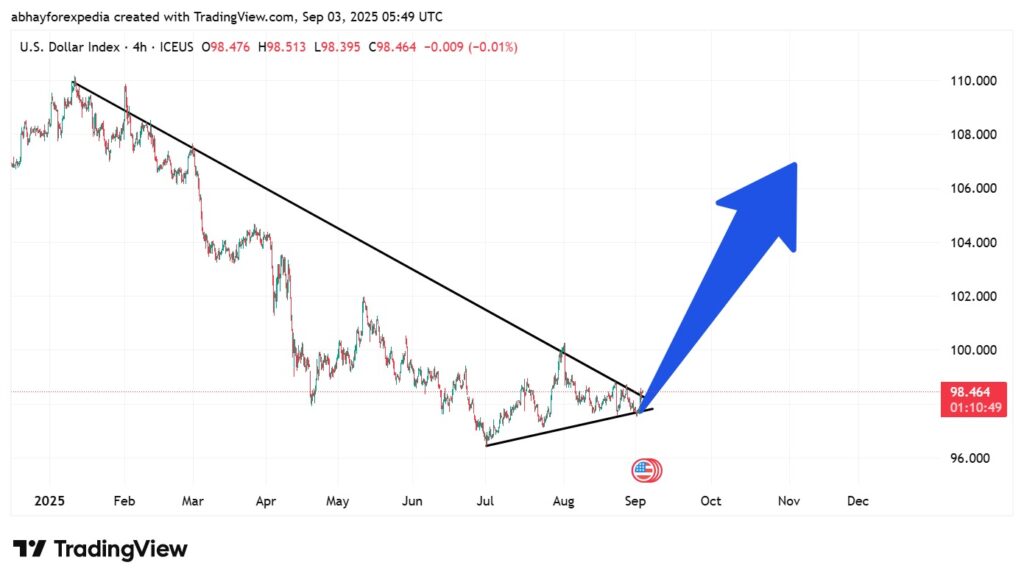
US dollar rebounds as risk aversion grips markets; USD/JPY eyes bullish breakout while AUD/USD faces downside risks after bearish reversal.
Markets reopened after Labor Day with a wave of risk aversion, as fiscal concerns, tariff uncertainty, and fresh political pressure on central banks rattled sentiment across the U.S. and Europe. A U.S. court ruling striking down part of Trump’s “reciprocal” tariffs only added to the fiscal unease. The dollar strengthened alongside Treasuries and, in a rare twist, gold surged in tandem underscoring the depth of the flight to safety.
Bond markets bore the brunt, with U.K. 30-year gilt yields spiking to levels last seen in the late 1990s, while yields across France and the U.S. also pushed higher. Sterling was among the hardest-hit currencies, with GBP/USD sliding as much as 1.5% intraday before closing about 1% lower. Pressure on the pound stemmed from expectations that Chancellor Rachel Reeves will unveil £18–28 billion in tax hikes in the autumn budget to shore up fiscal targets moves that risk dampening growth and investor appetite. A recent cabinet reshuffle by Prime Minister Keir Starmer, intended to reinforce economic credibility, instead added uncertainty over Reeves’s ability to deliver on the fiscal path ahead.
For traders navigating forex trading strategies, these policy shifts add extra volatility to GBP pairs and cross-currency setups.
USD/JPY and AUD/USD Price Action After US Dollar Rebound
USD/JPY Technical Analysis: US Dollar vs Japanese Yen
I’ve maintained a core bearish bias for USD/JPY, favouring an eventual downside break from its sideways range. Yet, more recently, I highlighted bullish potential near the lower bound of that range. After Tuesday’s surge, I’m now open to a deeper retracement higher and on guard for a temporary upside break of the 146.50–148.50 VPOC (volume point of control) band.
Notably, Tuesday delivered the most bullish daily performance for the US dollar against the Japanese yen in nearly five weeks. That bullish expansion candle was also the most volatile upside move since late July, with USD/JPY reaching its highest intraday level since August 1st.
The 1-hour chart confirms a sharp rally from 147.07 to 148.60, followed by two-way volatility and a developing 3-wave correction. With prices breaking above 148.60 at the start of Jerome Powell’s Jackson Hole speech, the bias heading into Nonfarm Payrolls (NFP) favours buying dips, targeting a push closer to 150. Should USD/JPY extend that far, I’ll reassess the potential for a swing high on the daily chart and a broader realignment with the bearish weekly trend.
For indices trading enthusiasts, such FX-driven volatility also ripples across global benchmarks like the S&P 500 and Nikkei 225.
AUD/USD Technical Analysis: Australian Dollar vs US Dollar
I also need to modify my near-term outlook on the Australian dollar in light of the burst of bearish volatility within its own range. For the past two weeks my preference has been for bulls to seek dips, though Tuesday’s bearish engulfing day leaves AUD/USD vulnerable to further downside over the near term. That is not to say dips may not become favourable again, but first I want some evidence of a potential swing low.
The 1-hour chart shows AUD/USD is trading around its weekly and monthly pivot points after recovering around half of its sharp selloff from Tuesday’s high. Sentiment would need to turn against the US dollar for AUD/USD to rebound and sustain its gains from here, which seems unlikely. Instead, I suspect at least one more leg lower for AUD/USD as part of an ABC correction.
Bears could fade into minor bounces in anticipation of AUD/USD falling back towards its 20-day EMA (0.6460).
This evolving setup reflects how the crypto market and FX often show similar volatility spikes during major U.S. macro events something traders consider when balancing crypto investment with currency exposure.