Key Points
- U.S. President Donald Trump said he has reached a 1-year agreement with China on rare earth supplies.
- Trump also cut fentanyl-linked tariffs on Beijing by half, taking overall duties on Chinese goods down to 47%.
- The American leader said he will be going to China in April, followed by Xi’s trip to the U.S.
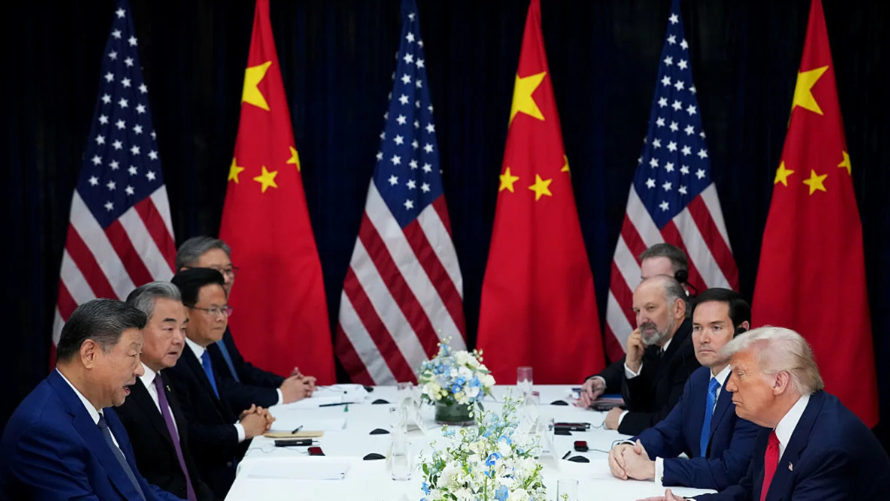
BUSAN, SOUTH KOREA U.S. President Donald Trump said he has reached a 1-year agreement with China on rare earths and critical minerals, and cut fentanyl tariffs on Beijing by half, as his meeting with Chinese President Xi Jinping concluded in South Korea on Thursday.
Trump told reporters aboard Air Force One as he left South Korea that the meeting with Xi was “amazing” and that “a lot of decisions were made.”
“Rare earth issue has been settled,” Trump said, adding that it was a 1-year agreement that will be negotiated every year. The fentanyl-linked tariffs will be lowered to 10% from 20%, effective immediately, Trump said, bringing down the levy on Chinese exports to 47% from 57%.
In return, Beijing will “work very hard to stop fentanyl” and resume purchases of American soybeans and other agricultural products a move that could also stabilize commodity-linked currencies and influence forex trading across global markets.
Soybean futures on the Chicago exchange were down 1.6%, while China’s CSI Rare Earths Industry Index was up more than 2%, according to LSEG data developments closely watched by indices trading professionals and investors engaged in crypto investment who view geopolitical shifts as early market signals.
On the sale of Nvidia’s chips to China, Trump said the two sides had discussed “a lot of chips” but not the most advanced Blackwell chips. “They are going to be talking to Nvidia and others about taking chips,” he said.
Taiwan was not part of the discussion, Trump said.
China has not officially confirmed these details. Its foreign and commerce ministries did not immediately respond to requests for comments.
The U.S. decision to cut fentanyl-related tariffs to 10% addresses “a key Chinese grievance,” said Han Shen Lin, China director at advisory firm The Asia Group, showing that “Beijing’s efforts to curb exports of fentanyl precursors, long unrecognized by Washington, are finally being acknowledged.”
Trump said he will be going to China in April, followed by a trip by Xi to the U.S., without specifying a timeline for his Chinese counterpart.
The results of the meeting, announced by Trump so far, are “exceeding expectations,” in part thanks to the two leaders’ personal diplomacy that was strong enough not only to halt the escalation but to deliver results that seemed unthinkable, said Alfredo Montufar-Helu, managing director at Ankura Consulting’s GreenPoint Business.
That said, frictions will not go away entirely as several bilateral issues core to the U.S.-China rivalry remain outstanding, he added an uncertainty that could create volatility across indices trading platforms and the crypto market, where traders often react to macro policy shifts and trade headlines.
It was the first time that the two leaders met in six years, and the meeting lasted one hour and 40 minutes.
Before the meeting, the two leaders struck a conciliatory tone, with Trump calling Xi “an old friend” with whom he has a “very good relationship,” and Xi stressing that China’s economic growth ambitions would not undermine Trump’s vision to “Make America Great Again.”
Tensions between the world’s two economic superpowers have been on a boil this year. The latest escalation came this month, with Beijing imposing export controls and Washington threatening to ban software-powered exports to China a development that analysts say could spill over into crypto investment sentiment and influence capital flows in both traditional and crypto markets.
The U.S. had in recent days shared details about deals they hoped to achieve with China from restricting the flow of fentanyl to the U.S. to TikTok’s divestiture from its Beijing-based parent ByteDance. Tariffs, tech curbs and rare earths were also on the table for discussion all of which hold implications for global traders, forex trading, and investors balancing portfolios between equities, commodities, and digital assets.
Beijing had been more circumspect about the prospects of an agreement, but in a possible sign of thawing relationship, China bought its first cargoes of U.S. soybeans in several months, Reuters reported Wednesday.