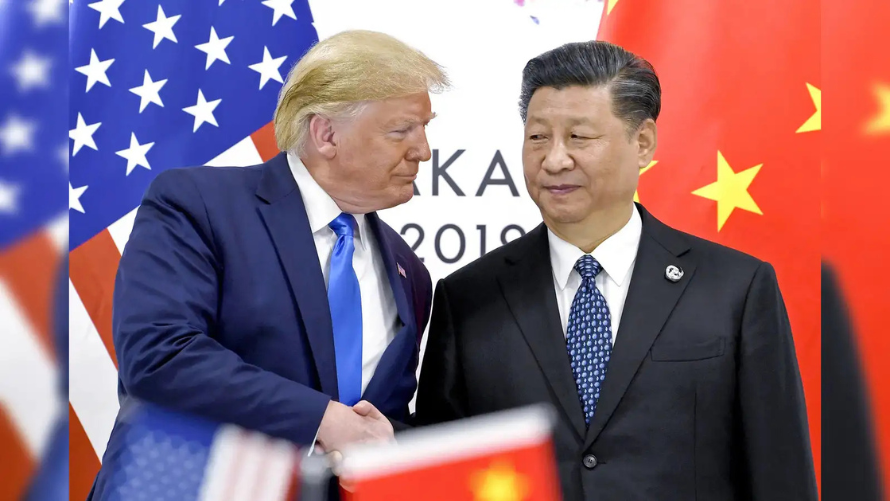
(Forexpediaa / Reuters / Bloomberg Composite Report) China vowed on Tuesday that it would “fight to the end” in its escalating trade conflict with the United States, following President Donald Trump’s announcement of a 100% tariff on Chinese goods and new export restrictions on critical software, effective November 1.
The hardline response from Beijing underscores how rapidly the latest chapter of the U.S.–China trade war is intensifying a development that has rattled global equities, indices trading benchmarks, forex markets, and even the crypto market as investors brace for potential retaliation.
China Draws a Red Line
“On the matter of tariff wars and trade wars, China’s position remains consistent,” said an unnamed spokesperson from China’s Ministry of Commerce in a statement.
“If you wish to fight, we shall fight to the end; if you wish to negotiate, our door remains open. The United States cannot simultaneously seek dialogue while threatening to impose new restrictive measures. This is not the proper way to engage with China.”
The statement came just days after Beijing announced sweeping export controls on rare earth materials a strategic sector where China holds a dominant global position. These controls, which target advanced components essential to defense and semiconductor industries, triggered Trump’s retaliatory tariff threat last Friday.
Trump’s 100% Tariff Threat Shakes Global Market
President Trump’s social media post on Friday caught global markets off guard, with Wall Street, oil, and crypto investments all tumbling as investors feared a renewed escalation in protectionist measures between the world’s two largest economies.
Trump’s move also sparked speculation over the fate of a potential meeting with Chinese President Xi Jinping scheduled for next month in South Korea. However, the president later softened his tone, writing that “it will all be fine” and that the U.S. “wants to help China, not hurt it.”
Markets responded cautiously to the mixed messaging. While U.S. stock futures rebounded slightly in early Asian trading, volatility persisted across forex pairs particularly USD/CNH and AUD/USD as traders adjusted their forex trading strategies to hedge against geopolitical risk.
The crypto market also mirrored this volatility: Bitcoin briefly dipped below $59,000 before stabilizing, while Ethereum and altcoins saw similar declines amid global uncertainty.
Beijing Stands Firm as Exports Show Resilience
Despite the rising tensions, China’s latest trade data painted a surprisingly strong picture.
According to official figures released Monday, exports jumped 8.3% year-on-year in September, the fastest pace since March and well above market forecasts. Shipments to the United States rose to US$34.3 billion, highlighting the resilience of Chinese trade even under heavy tariff pressure.
Currently, U.S. tariffs on Chinese goods stand at roughly 30%, with Beijing maintaining a 10% retaliatory levy. The Trump administration has accused China of unfair trade practices and alleged links to the fentanyl trade claims Beijing has repeatedly denied.
China’s Commerce Ministry defended its export curbs, stating:
“Export control measures concerning rare earths and related items constitute legitimate actions by the Chinese government to improve its export control system in accordance with laws and regulations.”
The ministry emphasized that China “resolutely safeguards its own national security and international collective security,” framing the restrictions as defensive rather than aggressive measures.
Ripple Effects Across Global Markets
The intensifying trade dispute is sending ripples through global markets. Indices trading benchmarks such as the S&P 500, Hang Seng, and Nikkei 225 all posted declines in the wake of Trump’s announcement, while the U.S. dollar strengthened against major Asian currencies.
For forex traders, this environment underscores the need for adaptive forex trading strategies that can navigate heightened volatility and policy uncertainty. Traders have shifted toward safe-haven assets such as the Japanese yen and the Swiss franc, while commodity-linked currencies like the Australian dollar have come under pressure due to their trade exposure to China.
In parallel, crypto investors are increasingly treating Bitcoin and Ethereum as alternative hedges against political risk. The ongoing trade war has reignited debate over the role of crypto investments as digital safe havens during periods of economic turbulence.
IMF and World Bank Meetings Put Tariffs in Spotlight
The timing of the latest escalation coincides with the International Monetary Fund (IMF) and World Bank meetings in Washington this week, where global trade policy is a central topic. The IMF has previously warned that prolonged tariff wars between the U.S. and China could shave as much as 0.7% off global GDP over two years.
Despite market jitters, the White House maintains that tariffs will ultimately benefit the U.S. economy. Officials argue that the short-term disruption has been offset by reshoring of manufacturing and rising domestic investment.
“The long-term effect of tariffs will be positive,” a senior administration source said, citing minimal economic fallout so far.
Broader Implications for Investors
The escalating U.S.–China conflict represents more than a bilateral dispute it’s a defining factor shaping global trading strategies, risk sentiment, and capital flows.
- For forex traders: Expect continued volatility in Asian currency pairs, with potential intervention by central banks if markets overshoot.
- For indices traders: Watch for defensive sector rotation into utilities and consumer staples as volatility rises.
- For crypto investors: Use disciplined risk management; volatility across traditional markets often spills into the crypto market, creating both risks and opportunities.
- For long-term investors: Diversified crypto investment portfolios may provide an inflation and policy hedge as central banks navigate rising geopolitical uncertainty.
Beijing’s vow to “fight to the end” marks a clear escalation in the U.S.–China trade war, reinforcing a geopolitical standoff that is shaking global markets and testing investor confidence.
While Trump’s softer comments hint at possible room for negotiation, both sides appear unwilling to concede ground for now. For traders and investors alike, this is a critical moment one where geo-economic strategy, forex trading discipline, and crypto market insight converge to define who stays ahead in a rapidly changing world economy.