Key Points
- President Donald Trump signed a funding bill to end the longest U.S. government shutdown in history.
- The House vote was 222 in favor and 209 against.
- Federal workers were instructed to return to work Thursday.
President Donald Trump late Wednesday signed into law a funding bill to end the longest federal government shutdown in U.S. history, restoring government operations and calming market volatility that had begun rippling through indices trading, forex markets, and crypto investment sentiment.
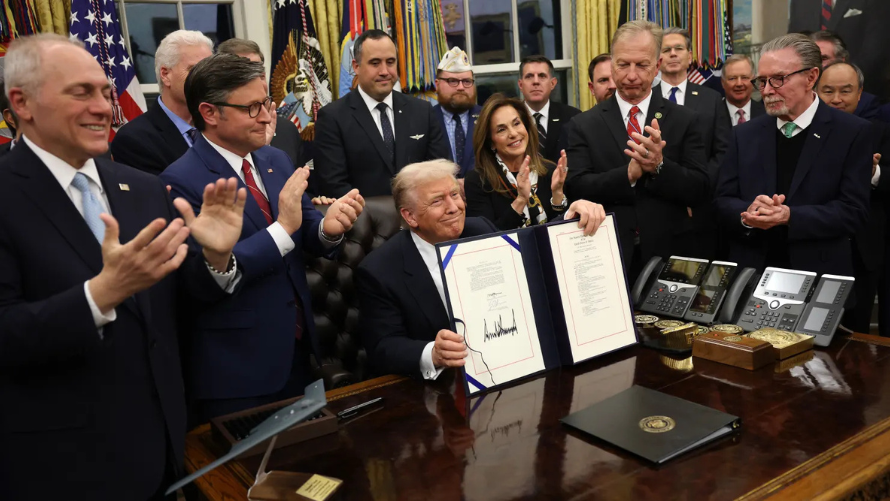
The legislation, passed by the House of Representatives in a 222-209 vote, funds the government through January 2026. “The Democrats tried to extort our country,” Trump said before signing the bill in the Oval Office, joined by House Speaker Mike Johnson (R-La.), Minority Leader Steve Scalise (R-La.), and other Republican lawmakers.
“Republicans never wanted a shutdown,” Trump said. “People were hurt so badly. We can never let this happen again.”
The President reiterated his call for the Senate to scrap the filibuster rule that requires 60 votes to pass legislation, including temporary funding resolutions.
Political Dynamics and Market Impact
The shutdown, which began October 1 and lasted 43 days, had paralyzed large parts of the federal government. Traders closely monitored developments, as uncertainty weighed on forex trading strategies and indices trading positions. The dollar index wavered as investors sought clarity on fiscal policy direction, while some market participants shifted toward crypto investment and safe-haven assets.
Analysts said the resolution may stabilize short-term risk appetite across the crypto market, equities, and bonds, particularly if government services resume smoothly and upcoming budget talks avoid further disruptions.
The House vote reflected deep partisan divisions: only two Republicans Thomas Massie of Kentucky and Greg Steube of Florida voted no, while six Democrats, including Jared Golden of Maine and Henry Cuellar of Texas, broke with their party to oppose the measure.
The Office of Management and Budget ordered federal employees to report back to work Thursday. The U.S. Department of Transportation also froze planned flight-cut expansions tied to air-traffic-controller shortages, noting that roughly 6 percent of flights had been canceled as of Tuesday a figure expected to double had the shutdown continued.
Policy Provisions and Economic Relevance
Under the agreement, Senate Republicans allowed Democrats a December vote on extending enhanced Affordable Care Act tax credits, which reduce costs for 20 million Americans. Without these credits, millions could face steep insurance premium hikes in 2026.
The deal also reverses all shutdown-related furloughs, guarantees full back pay for federal employees, and secures funding for the SNAP program, which provides food assistance to 42 million Americans. The Supreme Court had delayed a lower-court order mandating full SNAP payments until Thursday giving Congress time to render the issue moot by passing this bill.
Provisions were included to strengthen a bipartisan budget process and curb the White House’s reliance on continuing resolutions (CRs) a practice criticized for deferring long-term fiscal decisions and injecting instability into markets. Economists warn that recurring fiscal standoffs can fuel volatility across both traditional asset classes and the emerging crypto market.
Reactions on Capitol Hill
Rep. Rosa DeLauro (D-Conn.) warned on the House floor that some families will see their insurance premiums “double or even triple” next year without permanent ACA support. She accused Speaker Johnson of showing “no interest” in scheduling the promised ACA vote.
House Majority Leader Steve Scalise (R-La.) countered that Democrats “appeased their most radical base” during the shutdown, accusing them of hypocrisy for seeking $200 billion in health spending while “gutting the $50 billion Rural Health Care Fund.”
As political tensions ease, traders are watching how renewed fiscal stability may affect upcoming data releases and Federal Reserve policy outlooks. Analysts expect renewed positioning in forex trading strategies and indices trading, while speculative interest could return to crypto investment as broader risk sentiment improves.