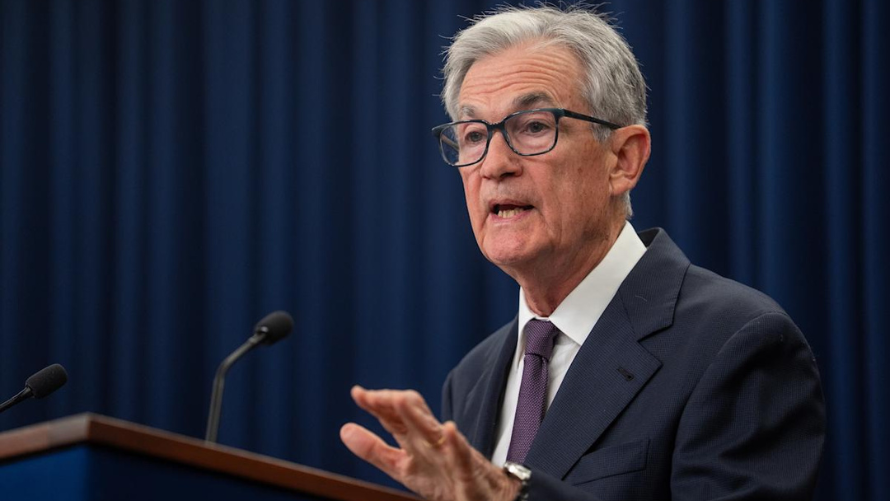
Federal Reserve Chair Jerome Powell said Tuesday that while the overall outlook for inflation and employment remains broadly unchanged since September’s policy meeting, the “downside risks to employment appear to have risen.”
The statement hinted that another interest rate cut could be on the table when the Federal Open Market Committee (FOMC) meets on October 28–29, even as Powell emphasized that monetary policy decisions will continue to be made “meeting by meeting.”
Policymakers have penciled in two more rate cuts for 2025, underscoring the Fed’s intent to balance its dual mandate of price stability and maximum employment. Powell reiterated that there is “no risk-free path,” noting that the Fed must manage the trade-off between containing inflation and supporting job growth in a shifting economic landscape increasingly influenced by global trade disruptions and crypto market volatility.
“These projections should be understood as representing a range of potential outcomes whose probabilities evolve as new information informs our meeting-by-meeting approach to policymaking,” Powell said during a speech at the National Association for Business Economics (NABE) conference in Philadelphia.
Employment Risk Signals a Softer Economy
Due to the ongoing government shutdown delaying official labor data, Powell acknowledged the Fed is relying more heavily on private-sector indicators such as ADP payroll data and state-level unemployment claims.
Preliminary evidence, he said, suggests that while layoffs remain low, hiring has cooled and both business confidence and household perceptions of job availability are weakening indicators consistent with a gradual labor market slowdown.
The Dallas Fed’s recent findings also point to a recalibration rather than a collapse in the job market, aligning with Powell’s view that the U.S. economy is rebalancing, not deteriorating.
Inflation, Tariffs, and the Policy Shift
On inflation, Powell said recent price increases in goods appear tied more to tariff-related cost pressures than to core inflationary momentum. That observation provides a crucial opening for policymakers to ease monetary policy without appearing to retreat prematurely from the inflation fight.
He noted that the Fed’s preferred inflation gauge, the core Personal Consumption Expenditures (PCE) index, currently stands at 2.9%, a level consistent with the Fed’s longer-run target trajectory.
Analysts in the forex trading community suggest that Powell’s dovish tone could lead to a softer U.S. Dollar Index (DXY) in coming months, especially as investors rotate toward forex trading strategies that favor higher-yielding currencies like the Canadian Dollar (CAD) and Australian Dollar (AUD).
Markets React Positively
Financial markets immediately responded to Powell’s remarks. The Dow Jones Industrial Average rebounded nearly 400 points on Tuesday, erasing earlier losses triggered by renewed U.S.–China trade tensions.
Investors on social media platforms and in crypto investment circles also cheered Powell’s tone, interpreting it as a signal of liquidity returning to financial markets a condition often favorable to risk assets such as equities, cryptocurrencies, and commodities.
“Powell signals end of balance sheet rolloff QT in September and affirms market expectations for more rate cuts in October and December,” noted economist Diane Swonk, highlighting the approaching end of quantitative tightening (QT).
The crypto market in particular saw an uptick in sentiment, with digital assets rallying modestly amid expectations that lower U.S. interest rates could weaken the dollar and boost demand for Bitcoin and Ethereum as alternative stores of value.
End of QT: What It Means for Markets
Powell confirmed that the Fed’s balance sheet runoff its effort to shrink holdings of Treasuries and mortgage-backed securities could conclude soon. The move would end the withdrawal of liquidity from the banking system, avoiding a repeat of the 2019 repo market crisis.
“We will set policy based on the evolution of the economic outlook and the balance of risks, rather than following a predetermined path,” Powell told investors, signaling a readiness to act if market conditions tighten too quickly.
The shift could also stimulate renewed flows into indices trading, particularly as U.S. equity indices like the S&P 500, Nasdaq Composite, and Dow Jones respond to a more accommodative Fed stance.
Bottom Line
With Powell’s dovish remarks, investors are reassessing the trajectory of U.S. monetary policy heading into 2026. The rising focus on employment risks, fading inflation concerns, and a possible halt in QT together signal that the Fed’s tightening cycle is near its end.
This evolving policy backdrop has broad implications not just for forex trading strategies and indices trading, but also for crypto investment as markets adjust to a lower-rate environment that could once again fuel speculative appetite across global asset classes.