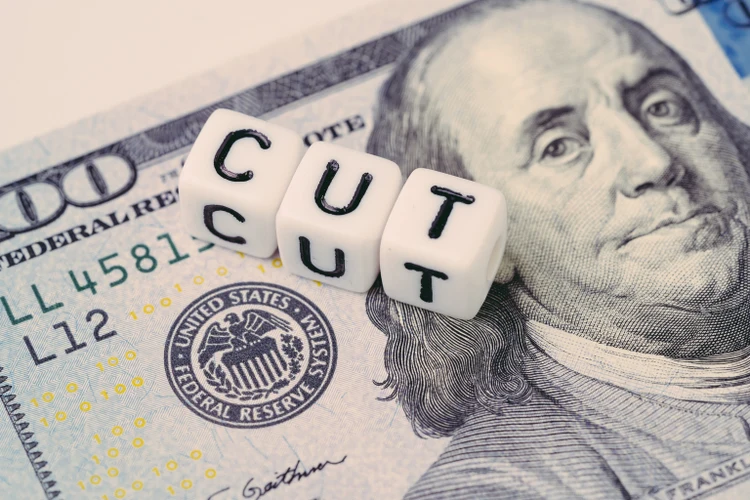
It’s tough to envisage a hawkish 25bp cut, else why do it in the first place? A dovish 25bp cut is far more likely. If Chair Powell wants to be hawkish, then better to deliver a 50bp cut. Long rates are in a mood to go along with the “rate-cutting ride” and test lower too. But rate cuts plus (likely) rising inflation present an issue for long dates to deal with ahead.
We expect the Federal Reserve to cut interest rates by 25 basis points.
In this article
- Over to the Federal Reserve now to deliver, and then it’s a focus on how long rates react
- EUR curves caught between competing US and domestic narratives
- Wednesday’s events and market view
Over to the Federal Reserve now to deliver, and then it’s a focus on how long rates react
Wednesday will see the Fed deliver an interest rate cut, most likely 25bp. It’s fully priced. So, material market impact would have to come from either a surprise 50bp cut, or commentary from Chair Powell that swings dramatically in either a decidedly hawkish or dovish direction. A 25bp cut gives room for a somewhat dovish leaning, while a 50bp cut would allow Chair Powell to be as hawkish as he likes, as the move itself would dominate aggregate impact.
Until or unless we get to an inflation hiccup of significance, the prognosis for the front end is pretty straightforward, as it will remain slavish to the trend lower in the funds rate. That said, the front end is priced for a series of cuts already, and now requires validation to keep them as is. The reaction of longer dates is open to more uncertainty. We’ve laid out our opinion on this here – basically, we see some downside to 10yr rates as we progress through the novelty period (the first cut), but beyond that, we expect to see the 10yr rate rise.
It’s always dangerous to rely on what happened the last time the Fed cut rates (September-December 2024), but that is what happened last time, as Fed cuts coincided with sticky inflation and a firming of the economy. The danger this time around is the economy has the optics of being weaker. Rate cuts should have the effect of blunting the macro weakness risk. But it still leaves us with a rising inflation risk in the coming months, which could pull long rates up with it.
Meanwhile, growing investor interest in the crypto market is influencing risk sentiment, as the weakening economy and shifting monetary policy outlook drive more attention toward crypto investment as a hedge against inflation or economic instability.
EUR curves caught between competing US and domestic narratives
With the 2y Schatz yield locked just atop the 2% level, Bund curve dynamics are currently driven more by the long end. The 10y yield still eyes the upside with the 10y Bund continuing to test above 2.7%, although with limited success. The German ZEW economic expectations index surprised to the upside and points to the structural upward pressure that we still see for long-end yields over the medium term. But for now, markets are looking more towards the US for the next cues with a close eye on what will come out of the Fed meeting.
Since initially peaking at 5% and then rallying some 30bp, the US 30Y has also been dragging long-end Bund yields lower. But already since last week, the 30y Bund has detached somewhat and was not even able to profit lastingly, for instance, from headlines earlier this week around a smaller Dutch pension fund delaying its transition to the new defined contribution system. Instead, we see more attempts to poke through 3.3%, and the 10s30s Bund curve even managed to resteepen somewhat.
While the macro shifts in the US cannot be ignored, the ultra-long end also follows its own narrative, mainly around the structural shifts in supply and demand balances. Actions of Dutch pension funds with a view to the reforms are one driver, but this week we will also be watching closely how Germany accommodates any supply increase in its 4Q issuance calendar update and how the Bank of England tweaks its quantitative easing schedule on Thursday.
An increased focus on forex trading strategies has emerged in recent months, as volatility in FX markets has accelerated due to diverging central bank policies and global geopolitical uncertainty. Traders are increasingly seeking tactical entry points to capitalize on short-term rate moves or inflation expectations.
Wednesday’s events and market view
There won’t be a lot in terms of data for markets to digest ahead of the Fed meeting on Wednesday. The eurozone releases final CPI data for August and the US releases housing mortgage applications and housing start numbers. More interesting should be what the numerous ECB speakers will have to say. Next to President Lagarde, the list includes Escriva, Muller, Cipollone, and Nagel.
As for the main event, markets price only a minimal chance that the Fed will cut rates by more than 25bp. The focus will be on the new set of projections and also the individual votes, with Stephen Miran participating for the first time.
In primary markets, we will see Germany auctioning two long-end lines (23y and 31y) for €2.5bn while Italy will be in the market with buybacks of six lines maturing in 2026 for up to €5bn.
Across global financial markets, indices trading remains a key avenue for investors adjusting their positions in light of the shifting monetary and economic environment.